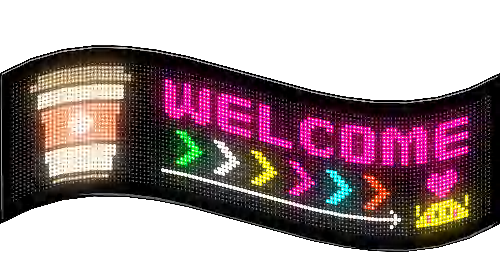
An LED matrix operates as a coordinated system of tiny individual light sources arranged in a grid, each capable of switching on or off—or varying its brightness—to create patterns, characters, animations, or full images. What appears to the viewer as a unified digital surface is actually an organized network of LEDs controlled by a driver system and a timing sequence that ensures every pixel responds precisely at the correct moment. The underlying mechanism combines hardware, digital logic, and signal processing. Modern versions of LED matrices, including flexible-format solutions like GMH’s GMH LED flexible display panels, take this concept further by enabling curved, cylindrical, and non-linear displays without losing pixel address accuracy or brightness uniformity. Understanding how an LED matrix works reveals why the technology is widely used across signage, architecture, stage production, and creative lighting applications.
At the most fundamental level, an LED matrix is a grid of LEDs. Each LED represents a pixel or a light point. These LEDs are not wired individually to a unique power line; instead, they are organized using a multiplexing system, making the matrix both efficient and scalable.
The matrix grid is typically arranged in either:
Row-column format—the most common setup
Modular panel format—used in commercial LED displays
Flexible substrate format—seen in advanced installations such as GMH’s GMH LED flexible display panels
In a standard LED matrix, each row shares a common electrical line and each column shares another. To illuminate a single LED, the controller sends current through the corresponding row line and column line simultaneously. By selecting specific row-column combinations, the system controls individual pixels within the grid.
Although this approach seems simple, it demands precise timing. Only one row (or column, depending on design) may be actively driven at a time. Through extremely rapid switching—thousands of cycles per second—the matrix appears continuously illuminated even though each LED is not powered 100% of the time. This principle, known as multiplexing, is the foundation of LED matrix operation.
Multiplexing is essential because it reduces the number of required control lines while still allowing full pixel-addressability. Instead of driving each LED independently, the controller switches between rows rapidly, lighting the correct LEDs in each row before moving to the next. This creates the illusion of a steady display.
A typical sequence involves:
Activating row 1
Sending a pattern to the columns
Turning off row 1
Activating row 2
Sending the next pattern
Repeating the sequence rapidly across all rows
This cycle is known as the refresh cycle.
Since the refresh happens at high frequency—typically 200Hz to 3840Hz in large displays—the human eye cannot detect the switching. The faster the refresh rate, the smoother the display appears, which is particularly important for:
Camera displays
Stage LED walls
Large outdoor screens
Curved flexible installations like GMH’s GMH LED flexible display panels
The refresh cycle must balance current load, brightness stability, and thermal management. Higher refresh rates require robust driver chips and stable power distribution so that each pixel maintains consistent output during its short “on” time.
While the LEDs form the visible portion of the matrix, the real intelligence comes from the driving circuitry. LED drivers convert digital instructions into controlled current sent to each pixel. A controller—either a microcontroller, FPGA board, or dedicated LED processor—determines which LEDs should be lit and when.
Drivers regulate:
Current level
Brightness through pulse-width modulation (PWM)
Color mixing for RGB LEDs
Refresh sequencing
Pulse-width modulation is central to how LED matrices display grayscale. Each LED is switched on and off rapidly. The proportion of time it remains on defines its brightness level.
For example:
| PWM Duty Cycle | Human-Perceived Brightness |
|---|---|
| 10% | Very dim |
| 50% | Medium brightness |
| 90% | Very bright |
The switching happens so quickly that the human eye blends the flickers into smooth brightness gradients.
In RGB matrices, each pixel contains a red, green, and blue LED. By altering the PWM duty cycle of each color channel, the panel generates millions of possible colors.
Using high-quality driver ICs ensures:
smoother color transitions
flicker-free performance
consistent brightness across all pixels
This is especially important for premium visual applications using advanced panels such as GMH’s GMH LED flexible display panels, where color uniformity must remain accurate even when the display is curved or wrapped around objects.
Beyond lighting pixels, an LED matrix must interpret and process incoming data. Whether displaying a simple scrolling text pattern or a full-motion video feed, the device relies on a communication workflow that ensures every pixel receives correct instructions.
The typical data flow works like this:
Input Source – content loaded from software, controller cards, microcontrollers, or media players
Signal Transmission – sent through data cables or fiber systems depending on panel size
Data Decoding – the driver chip interprets the incoming data stream
Pixel Address Allocation – each LED is assigned coordinates inside the matrix
Timing and Synchronization – ensures every row updates at the correct moment
For multi-panel assemblies—especially curved or creative layouts—the addressing becomes more complex. Each module must be mapped accurately so that the visual content appears as one continuous screen. Flexible screens like GMH’s GMH LED flexible display panels require even more advanced mapping due to non-linear shapes.
Incorrect addressing can cause:
shifted text
inverted images
incorrect pixel colors
broken animations
This is why high-resolution installations depend on robust controller software capable of handling precise layout mapping.
LED matrices require careful power and heat management to function reliably. Every LED consumes energy, and in large or high-brightness matrices, power demand grows significantly. Without stable distribution and cooling, the panel may dim, flicker, or overheat.
Proper performance depends on three engineering principles:
Balanced power distribution
LED panels often receive power from multiple points, ensuring uniform voltage across the matrix. Voltage drops lead to dim edges or color distortion.
Effective thermal management
LEDs produce heat, and drivers generate even more. Panels must dissipate heat through metal substrates, ventilation gaps, or heat-conductive materials. Flexible LED systems such as GMH’s GMH LED flexible display panels use engineered PCB materials that manage heat even when curved.
Structural support and material durability
Rigid matrices rely on aluminum frames; flexible matrices rely on bendable PCB and silicone substrates that maintain electrical integrity under continuous shaping.
Failing to manage these elements can shorten lifespan or degrade image quality. High-quality matrix systems use optimized power buses, reinforced solder joints, and materials that ensure stable operation across long display hours.
The effectiveness of an LED matrix stems from the combination of efficient wiring, intelligent drivers, rapid refresh cycles, and robust display mapping. This allows the matrix to achieve brightness, color depth, and viewing clarity far superior to older lighting technologies. Its modular nature makes it scalable—from tiny badge-sized displays to building-sized digital screens.
LED matrices work exceptionally well in:
Digital signage
Stage and entertainment backdrops
Retail visual merchandising
Architectural illumination
Creative installations using curved surfaces
This is where flexible LED technology, such as the GMH LED flexible display panels, becomes especially influential. Flexible matrices allow designers to create visually immersive LED shapes, cylindrical displays, wave structures, and artistic lighting forms that rigid panels could never achieve.
By harnessing multiplexing, PWM brightness control, RGB color mixing, pixel addressing, and modular construction, LED matrices offer a highly adaptable and visually powerful display platform. Their technical simplicity at the component level contrasts with the sophistication achieved at the full system level, making LED matrices one of the most impactful technologies in modern visual communication.
An LED matrix works by arranging LEDs in a grid of rows and columns, driving them with multiplexing circuits, controlling brightness through PWM, mapping pixel signals through a controller, and stabilizing the system through careful power and heat management. The result is a stable, bright, color-accurate display capable of showing text, graphics, or full-motion content. Advanced versions like GMH’s GMH LED flexible display panels enhance these capabilities by enabling curved or creative shapes without compromising pixel precision. By understanding how each layer functions—from individual LEDs to the complete visual surface—users can better harness LED matrices for innovative applications.
Previous: How Long Do LED Strip Lights Last?