Controlling an LED matrix means telling many LEDs when to turn on, how bright to be, and what pattern or animation to show. Whether you are building a small pixel board for signage or installing a large curved surface for a commercial space, the control logic is the same: a controller sends data to pixels or modules, power is distributed safely, and software maps content to the physical layout so the image looks correct.
This guide explains the main ways to control an LED matrix, how to choose controllers and protocols, how to plan power and data lines, and how to troubleshoot common problems. If your project needs flexible shapes, curved installations, or creative architectural surfaces, GMH offers configurable solutions in its LED flexible display screen range.
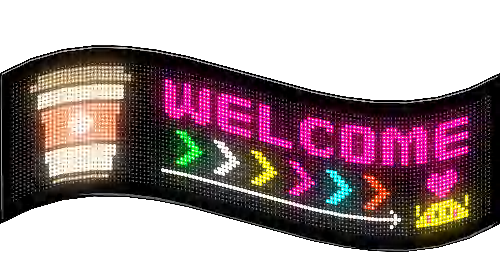
An LED matrix is a grid of LEDs or pixels arranged in rows and columns, or as a tiled surface made from modular panels. Control can be done in two common structures:
Addressable pixels, where each LED or pixel has its own data address and can show different colors and brightness.
Scanning matrices, where LEDs share row and column lines and the controller rapidly scans them to create the illusion of a steady image.
For commercial display surfaces, many systems are closer to modular panel control than hobby-style LED strips. Panels are driven by receiving cards and scan drivers, while the main controller or sending device pushes content to the whole screen.
Microcontrollers are commonly used for smaller addressable matrices. They generate the pixel data stream, handle animations, and can integrate sensors or buttons. This approach is flexible for custom effects, but it requires programming and careful power design.
For professional displays, dedicated controller systems are used because they support stable refresh rates, multi-panel synchronization, and real content input. These systems typically include a sending controller, receiving cards in the screen, and scan driver ICs that refresh LEDs by rows.
This method scales better, supports higher resolution, and is easier to maintain for commercial projects.
Many commercial LED matrix installations are controlled by a PC, industrial player, or media box that outputs content through a controller system. This is common for retail advertising, stage backdrops, exhibitions, and building interiors where scheduling and remote updates are needed.
GMH’s LED flexible display screen solutions are built for these professional control scenarios, especially when the screen must bend, wrap, or fit creative surfaces.
To control an LED matrix reliably, you need to manage three technical pillars:
The controller must speak the right protocol for the LED Module or pixel type. Addressable pixels require strict timing. Professional LED panels rely on structured data links between sending and receiving cards, with scan drivers converting incoming data into LED refresh signals.
Mapping is the translation between the content canvas and the physical LED layout. If mapping is wrong, text may appear mirrored, rotated, offset, or broken across panel seams. Flexible screens add complexity because panels may curve or be installed in non-rectangular shapes.
A good control system maintains stable refresh and smooth brightness steps. In professional displays, refresh rate affects image stability, and grayscale depth affects how smooth gradients and dim scenes look. A stable control chain prevents flicker, banding, and visible scan lines.
Controller choice depends on screen type, resolution, and how the content will be delivered.
Key selection points:
Screen resolution and total pixel count, which determine bandwidth requirements
Input sources such as HDMI, network content, or stored playlists
Whether the display needs remote management and scheduling
Required refresh stability for camera-facing scenes, events, or broadcasts
Environmental stability expectations for long runtime installations
For flexible LED screens used in retail, architecture, or event builds, the controller must also support stable synchronization across curved sections and irregular layouts.
Power problems cause most LED matrix failures. An LED matrix draws significant current, especially at high brightness and white content. Power planning must consider supply capacity, distribution, and voltage drop.
Practical power planning rules:
Use power supplies with margin so they do not run at full load continuously
Distribute power injection points so the screen maintains uniform brightness
Use correct wire gauge to reduce voltage drop over distance
Separate power and data routing to reduce noise and interference
Ensure grounding is consistent across controller, supplies, and panels
| Planning Item | What to Target | Why It Matters |
|---|---|---|
| power supply sizing | Extra capacity beyond peak load | Reduces heat and improves stability |
| Power distribution | Multiple feeds for large screens | Prevents dim corners and voltage drop |
| Cable gauge | Match current and distance | Improves uniform brightness |
| Data routing | Short, clean paths | Reduces signal errors |
| Grounding | Single stable reference | Prevents noise and intermittent faults |
In commercial builds, stable power distribution is as important as the controller itself because uneven voltage can cause color shift, flicker, or random pixel faults.
This workflow reflects how professional flexible LED projects are typically implemented, from hardware to content.
Start with screen dimensions, pixel pitch, and how the panels will be arranged. For flexible screens, confirm curvature radius and mounting structure so modules are not forced beyond their design tolerance.
Choose a sending controller and receiving system that matches your screen resolution and installation scale. Confirm input method, network control needs, and refresh requirements.
Calculate total load and define how many power supplies will be used. Plan injection points so each area receives stable voltage. Keep cable runs short and balanced.
Install panels according to the layout. Connect receiving units and scan drivers as required by the system. Maintain clean cable management to prevent stress at connectors, especially on curved surfaces.
Use the control software to map the physical layout. Then calibrate brightness and color uniformity if the system supports it. Correct mapping is essential for readable text and consistent visuals.
Define playlists, scheduling, or live input behavior. Confirm standby brightness for night mode if required. Test different content types, including gradients and video motion, to confirm stability.
For projects that require curved and creative surfaces, GMH’s LED flexible display screen products are designed to support flexible installation forms while maintaining consistent display performance.
This is often caused by power supply overload, poor grounding, or incorrect refresh settings. Reducing peak brightness, improving power distribution, and verifying controller settings typically resolves it.
This is usually a mapping configuration problem. Recheck cabinet order, direction, and starting pixel position in the software.
This is commonly voltage drop or uneven power injection. Add power feeds closer to affected areas and verify cable gauge.
This can be caused by loose data connections, cable stress on curved sections, or electrical noise. Reseating cables, improving strain relief, and separating power and data routing can improve reliability.
Flexible LED screens are often chosen for curved walls, pillars, stage shapes, and creative displays. This creates control challenges because the screen may not be a simple rectangle, and cables may route differently across curved structures.
A well-designed flexible screen system helps control work more smoothly by supporting stable module connections, consistent refresh behavior, and repeatable mapping. GMH focuses on flexible display solutions that support creative installations without sacrificing practical control and maintenance requirements. You can review options here: LED flexible display screen.
Controlling an LED matrix requires a stable controller chain, correct mapping, and well-planned power distribution. Small matrices can be controlled by microcontrollers, while commercial LED surfaces typically rely on sending controllers, receiving units, and scan drivers to deliver stable refresh and accurate grayscale. In flexible installations, mapping and cable management become even more important because the layout may curve or wrap around structures.
If your project needs a flexible LED surface with reliable control compatibility for commercial content playback, explore GMH’s LED flexible display screen solutions.
Previous: Can You Cut LED Strip Lights?